
Ukraine’s agrarian map is rapidly changing, with western regions increasingly asserting themselves as new centers of technological gravity. In just a few weeks, the Lviv Oblast village of Kholodnovidka will host an event of special significance – Agro Lvov Field Day 2026, which will take place in this region for the first time on June 24-25.
Proximity to the European border and the specific local terrain have shaped a unique agricultural model in the Lviv Oblast. Here, they have learned to profit not from the quantity of raw materials, but from their quality and deep processing. The region has virtually no classic dominance of giant latifundia; instead, approximately 1.4 thousand enterprises operate, where large companies share the market with agile family farms.
For such a dynamic region, the emergence of its own Field Day from Agro Team Expo is not just another machinery exhibition. It’s the launch of a local business platform where farmers won’t be offered abstract “giant machines” for the steppes. In Kholodnovidka, the focus will be on smart, maneuverable machinery, precision farming technologies for small field contours, intensive horticulture, and tools that automate processes amidst a shortage of labor.
The primary value of this year’s premiere in Kholodnovidka is localization. In the very heart of the season, producers don’t need to waste time on distant logistics: all advanced solutions – from energy-efficient machinery in action to precision farming innovations and flexible financial programs – will be gathered in one place. This is a unique opportunity to see firsthand the tools that can optimize costs and increase the profitability of each specific hectare.
How does Lviv Oblast manage to retain a fifth of its GDP thanks to the agricultural sector, why do relocated businesses choose this region, and what financial instruments is the oblast preparing to support small producers and veterans?
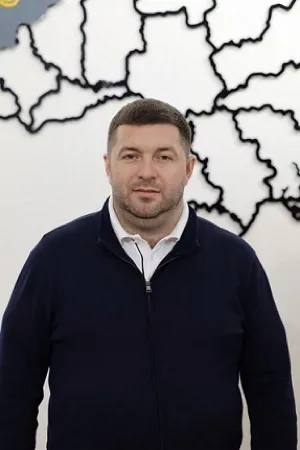
Yuriy Buchko, Deputy Head of the Lviv Oblast State Administration
On the eve of the Field Day, we managed to speak with Yuriy Buchko, Deputy Head of the Lviv Oblast State Administration.
Agro Team Expo: What does the agrarian Lviv Oblast represent today, and how has it changed over the four years of full-scale invasion?
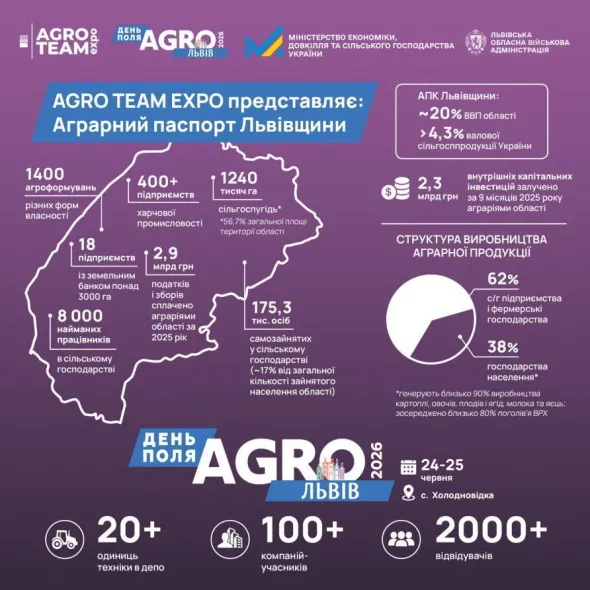
— The agricultural production in Lviv Oblast is based on about 1.4 thousand agricultural formations of various forms of ownership and scales – from family farms to large agricultural enterprises. They are involved in growing grain and technical crops, vegetable farming, fruit growing, and animal husbandry.
Before the war, the number of such agro-businesses was around 1.2 thousand enterprises.
The positive trend indicates that, despite the difficult wartime conditions, agricultural formations continue to operate and develop gradually, and entrepreneurial activity in the agricultural sector is maintained.
The export of agricultural products from Lviv Oblast remains stable amidst the war. The share of the agro-industrial complex in the total export structure of the oblast is 36.6% and continues to be one of the key drivers of foreign trade. Exports are primarily composed of fats and oils, grain crops, sugar and confectionery products, fruits and vegetables, and meat.
In addition to the raw material component, over four hundred food industry enterprises operate in the region’s agro-industrial complex. Lviv Oblast has long and consistently developed deep processing and the production of high value-added products. Today, meat processing, milk processing, baking, and flour milling operations are active within the oblast, providing the population with basic food products.
Concurrently, the production of beverages, confectionery, canned goods, oils, and fats is actively developing.
In summary: despite the war and logistical challenges, Lviv Oblast’s agricultural business demonstrates adaptability, gradually transitioning from a raw material model to higher value-added products, which forms the basis for further growth and strengthening of positions in foreign markets.
Agro Team Expo: If we summarize, is agrarian Lviv Oblast more of an agroholding or a farming enterprise?
— It is a unique, market-healthy combination of large-scale production and a significant role for small farms. Approximately 62% of agricultural production is generated by agricultural enterprises and farms, while 38% comes from household plots. The former specialize in the production of grain crops, sugar beets, rapeseed, sunflowers, soybeans, and meat, focusing on both domestic and export markets. The latter play a key role in producing labor-intensive products, accounting for about 90% of potato, vegetable, fruit, and berry, milk, and egg production. Furthermore, about 80% of the cattle population is concentrated in the individual sector, making them strategically important for the development of animal husbandry.
The agrarian model of Lviv Oblast represents a balance where large enterprises ensure volume and efficiency, while small farms provide food diversity and stability.
Agro Team Expo: What is the share of the agro-industrial complex in the regional economy’s structure?
— The agro-industrial complex of Lviv Oblast accounts for about 20% of the oblast’s GDP and ensures the production of over 4.3% of Ukraine’s gross agricultural output.
Agro Team Expo: What land resources provide this figure?
— The agricultural land area of Lviv Oblast is 1,240 thousand hectares, or 56.7% of the total area of the oblast. The sown area for agricultural crops exceeds 770 thousand hectares and grows annually by additionally involving arable land into agricultural circulation. This is facilitated by both the transfer of land for lease from land share owners and the holding of auctions for the right to lease agricultural land of communal ownership, which allows for more effective use of available land resources.
Agro Team Expo: Does the scale of agricultural production correlate with local budget revenues?
— Yes, and this indicator is steadily increasing. Against the backdrop of current economic and security challenges in the country, the importance of such dynamics is hard to overestimate.
In 2025, agrarian producers in the oblast paid UAH 2.9 billion in taxes and fees, which is almost UAH 0.6 billion more compared to 2024, or a 25% increase.
Local budget revenues increased due to a 27% rise in personal income tax (PIT) in 2025 (UAH 1.3 billion paid). The share of PIT in the total structure of taxes paid is 45%.
Agro Team Expo: If we characterize the region’s agriculture as an employer, what is it like?
— Exceptional. Out of the 2.5 million population of Lviv Oblast, 961.8 thousand people, or 39%, are rural residents, which leads to a significant number of personal peasant farms. Among them are many that effectively carry out production, cultivating from 2 to 10, and sometimes up to 50 hectares of land. The number of self-employed in agriculture is 175.3 thousand people, or about 17% of the total employed population of the oblast.
Additionally, about 8 thousand hired workers are employed in the sector. The produce is used not only for own consumption but is also actively sold in the market.
We aim to support such farms and encourage their gradual transition to more organized forms of activity, particularly the establishment of family farms. This process is already showing positive results: as of today, 158 family farms are registered in the oblast, which is perhaps the highest indicator among the regions of Ukraine.
Agro Team Expo: Lviv Oblast has repeatedly been targeted by the enemy, yet it is perceived as a safe haven for both citizens and businesses. How many agro-industrial enterprises have been relocated to the oblast since February 2022?
— Since the beginning of the full-scale invasion, over 10 agricultural and related processing enterprises from other regions have been relocated to Lviv Oblast.
Importantly, some of them have not only relocated their operations but have also established new production facilities within the oblast, such as Lviv Confectionery Complex LLC, or acquired existing farms, like VREMYA Farm from Donetsk Oblast, which purchased the MERINOS-ZAKHID Farm.
Among the relocated enterprises are producers of crop and livestock products, as well as processing enterprises manufacturing snacks, jerky, herbal teas, cocoa, confectionery, and bread.
The relocation of agricultural enterprises is significantly more complex than that of processing enterprises, as it requires forming a new land bank, obtaining land rights, and consolidating plots into a contiguous area. This demands considerable time and financial resources, and does not always allow for the restoration of the previous level of efficiency due to differences in soil conditions, infrastructure, logistics, and staffing.
At the same time, examples of successful adaptation, such as “SNEK TREYD YUEY,” relocated from Kyiv Oblast to Lviv Oblast in 2022, demonstrate the ability of enterprises to quickly recover and even increase production, enter new sales markets, and strengthen export positions.
Agro Team Expo: In recent years, the amount of funds allocated from the oblast budget to support the agricultural sector has been among the largest in Ukraine. Why was supporting the agro-industrial complex identified as a priority?
— Local authorities and oblast council deputies well understand the significant role of agriculture, which constitutes a substantial portion of the region’s gross domestic product.
UAH 22 million have been allocated from the oblast budget to support farmers in 2026. The funds are primarily directed towards supporting agricultural producers engaged in cattle farming.
In 2026, the support program for partial subsidization of financial leasing for the renewal of agricultural machinery and equipment will also continue.
A special emphasis has been placed on supporting war veterans – they have the opportunity for compensation of expenses incurred for the acquisition of basic production assets. Furthermore, in 2026, a new financial support initiative has been introduced in the oblast for business entities growing vegetable crops (excluding potatoes), melons, and legumes (excluding soybeans). Support will be provided as a subsidy per hectare of cultivated land.
The main focus of the oblast program is on supporting micro, small, and medium-sized business entities engaged in agricultural production.
However, it must be stated that the agricultural business is exceptionally active and does not rely solely on state support. In just the first 9 months of 2025, agricultural producers in the oblast attracted UAH 2.3 billion in domestic capital investments. In 2026, 21 more investment projects in the agricultural sector are being implemented in the oblast.
Agro Team Expo: Can the Field Day, supported by the Lviv Oblast Administration, be interpreted as a component of the region’s agricultural investment development?
— Absolutely. We proceed from the premise that the times of planned economy are long gone, and industry professionals themselves best understand their priorities and needs. The state supports initiatives aimed at increasing production efficiency and profitability and welcomes industry-wide events that promote innovation and experience exchange. It is wonderful that Lviv Oblast will become a platform for such Expos, and agricultural producers will have the opportunity to familiarize themselves with the latest solutions and technologies without leaving the oblast.
Agro Team Expo: What effect do you expect from the Agro Lvov Field Day 2026 for the region’s agrarian sector?
— I am confident that every farmer attending will take something valuable away from this event, according to their specific needs. For our part, we support and stimulate any business activity in the agricultural sector aimed at enhancing the sector’s capacity, increasing the number of jobs, and ultimately strengthening the Ukrainian state.
For reference. The conversation with Yuriy Buchko, Deputy Head of the Lviv Oblast State Administration, clearly demonstrates: the oblast’s agricultural sector is confidently breaking old stereotypes. Today’s reality requires farmers to be not just raw material producers but agile businessmen who calculate logistics to the European border, invest in deep processing, and work efficiently on every hectare.
The holding of the debut Agro Lvov Field Day 2026 in the village of Kholodnovidka is a logical response to market demand. Agro Team Expo creates not just an exhibition platform, but a unique ecosystem where small family farms, relocated enterprises, and large agricultural companies can find tailored solutions for their needs.
Initiating such a tradition specifically in Lviv Oblast is an investment in the financial stability of the entire region, which derives a fifth of its GDP from working the land. Two days of intensive networking and demonstrations lie ahead – it’s time to put new technologies into action!
See you in the field!